A safety report is a comprehensive document that demonstrates that a facility has identified, assessed and managed the major accident risks associated with hazardous chemicals. Protect helps your company to produce a clear, comprehensive safety report that meets regulatory requirements.
What is a safety clearance?
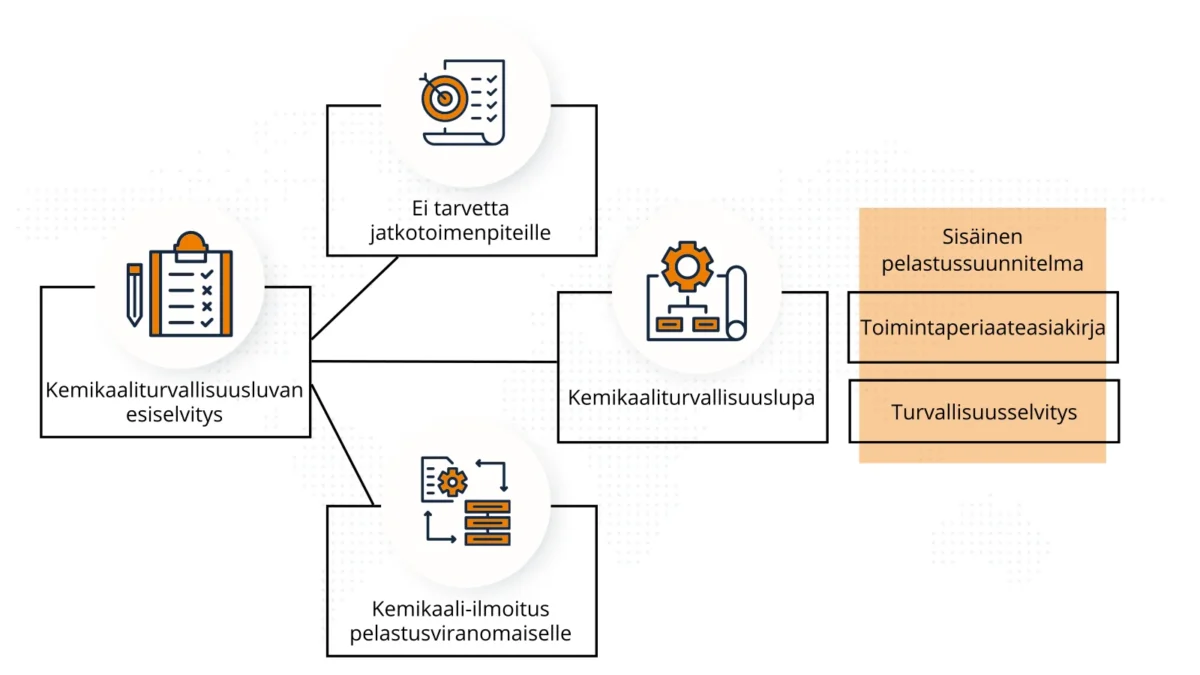
The safety obligation is based on the Chemicals Safety Act (390/2005) and the Government Decree on the Control of Handling and Storage of Dangerous Chemicals (685/2015), and it is submitted to Tukes and other authorities for approval before the start of operations or a significant change. It applies to operators that fall into the broadest control category based on the quantities of hazardous chemicals. The safety report describes in detail the operation of the facility, the chemicals used, the risk management measures, the safety management system and the preparedness for possible accident situations. A well-drafted report is also a concrete tool for ensuring safety and continuous improvement.
For whom is a safety clearance relevant?
The safety report is aimed at all operators who handle or store hazardous chemicals on a large scale in a way that falls within the scope of the SEVESO Directive. This includes chemical plants, fuel and storage terminals, energy plants, explosives handling and other production facilities where quantities of dangerous chemicals exceed the thresholds set out in the regulations. The requirements of the safety report apply to both new and existing installations and must be updated regularly or whenever there are significant changes in operations.
What does a safety report contain?
A high-quality safety report covers all the areas required by Tukes and the legislation in a clear and practical way.
It includes:
-
A description of the plant and operations – location, processes, structures and chemicals handled.
-
Risk assessment – identification of major hazard risks, assessment of probability and consequences, and risk management measures.
-
Safety management system – practices and procedures to ensure safety, such as training, change management and maintenance.
-
Emergency preparedness – internal and external emergency plans, alert and information procedures and drills.
-
Information for the public – clearly set out safety measures and guidance for residents and stakeholders.
-
Update and maintenance procedures – ensuring that the report remains up to date and supports continuous safety improvement.
A well-drafted report not only meets the requirements of the authorities, but also serves as a practical tool for safety management and risk management in the day-to-day operations of the plant.
How can Protect help?
Protect is your partner at all stages of the safety clearance process – from mapping to documentation and communication with the authorities.
Our experts will ensure that your report is not just a legal compliance exercise, but a truly effective tool for risk management and safety improvement.
Do you need help to prepare or update your safety report?
Contact usand we will take stock of your situation and ensure that all requirements are met efficiently and correctly.