- Blog
- chemical labels
- Chemical Safety
- hazardous chemicals
- storage of chemicals
Principles and labeling for the safe storage of chemicals

This article is the third in Protect’s series on chemical safety, which offers practical insights into the safe and responsible handling of chemicals. This time, the topic is chemical storage and labeling. The article reviews the principles of safe storage, labeling, and the most common storage mistakes.
Safe handling and storage of chemicals in the workplace
The safe handling and storage of chemicals is a key part of workplace safety, environmental protection, and risk management. Improperly stored chemicals can cause fires, explosions, toxic exposure, and serious environmental damage. With carefully planned storage, most hazardous situations can be prevented in advance.
An up-to-date list of chemicals, safety data sheets, and emergency procedures must be available.
The most common mistakes related to chemical storage are incomplete or missing labels, storing incompatible chemicals in the same space, and neglecting leak protection. Expired or unidentified chemicals must not be stored; they must be taken out of use and disposed of properly.
Storage location markings and chemical identification
The storage location for chemicals must be clearly marked and easily identifiable. Warning labels indicating the hazards posed by chemicals, such as flammability, corrosiveness, or oxidizability, must be visible in the storage area. All containers and packaging must be clearly labeled. The original labels must be visible on the chemical containers. If a chemical is transferred from one container to another, the name of the chemical and its hazardous properties must be added to the new container.
GHS labels as an aid to chemical identification
GHS (Globally Harmonized System) labels are an internationally standardized way of labeling chemical hazards. Their purpose is to help users quickly and easily identify the risks posed by chemicals, regardless of language or country.
GHS labels are red diamonds with a black hazard pictogram inside. Each symbol represents a specific hazard, such as flammability, toxicity, corrosiveness, or environmental hazard. A single chemical may have several GHS labels if it poses multiple hazards. Use the correct personal protective equipment when handling classified chemicals. The necessary information on the correct protective equipment can be found in the safety data sheets.
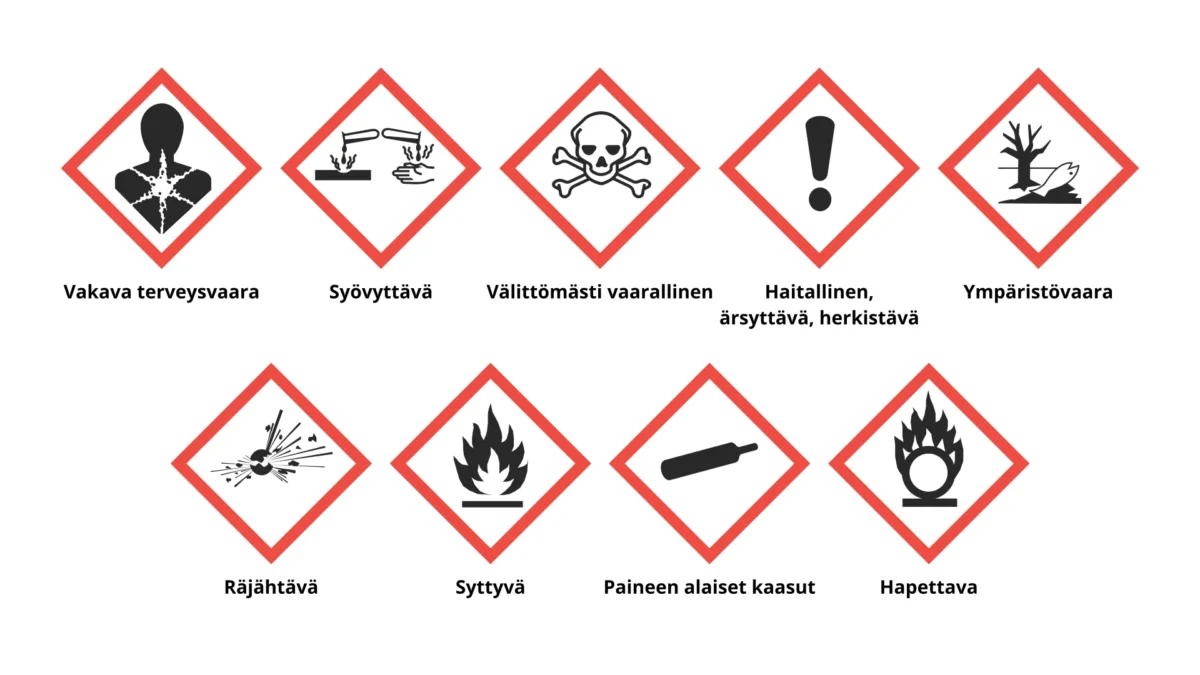
GHS labels can be divided into three main groups according to whether they describe the health effects, environmental hazards , or physical hazardsof a chemical. Understanding GHS labels is particularly important when storing chemicals. Recognizing these labels is also essential when assessing the compatibility of chemicals.
The labels can be used to assess the risk factors (including fire, serious health or environmental hazards). None of these chemicals should be allowed to enter drains, soil, or waterways, and adequate spill protection should be used when storing them.
GHS labels indicate health hazards
Health-related GHS labels describe the effects of chemicals on human health in the short or long term. These include, for example, toxicity, corrosiveness, and serious long-term effects.

Such labels warn, among other things, that the chemical may be dangerous if inhaled, swallowed, or in contact with the skin, causing skin or eye corrosion, allergic reactions, or long-term health hazards such as cancer or reproductive disorders.
Labels indicating environmental hazards
GHS labels related to the environment indicate the harmful effects of a chemical on the environment, particularly on aquatic environments and the ozone layer. The environmental hazard symbol warns that the chemical may be toxic to fish, aquatic organisms, or other wildlife, either immediately or in the long term. The hazard symbol warns of a risk to the ozone layer.

The labels help identify chemicals that require special care when handling in order to protect the environment.
GHS labels indicating physical hazards
Physical GHS labels describe the properties of chemicals that may cause immediate accident hazards, such as fires, explosions, or violent reactions. These include flammable, explosive, oxidizing, and pressurized substances.

Labels indicating physical hazards provide guidance specifically on storage solutions and fire safety. They indicate the need to keep chemicals away from sources of ignition and excessive fire loads, and to ensure adequate ventilation.
GHS labeling and CLP Regulation
The identification and communication of chemical hazards are based on GHS labels and the CLP Regulation, which are closely related but have different roles. The GHS system is not a law but serves as a global guideline. It is an international system developed by the UN that defines common principles for the classification and labeling of chemical hazards.
The European Chemicals Agency (ECHA) has issued the CLP Regulation, which includes the GHS system. The CLP Regulation is binding on EU member states. The regulation specifies in detail how chemicals must be classified, labeled, and packaged, and how hazards must be presented to users. Safe storage of chemicals requires that these labels are known and can be interpreted correctly.
Chemical Spill Management and
prevention
Leak control is an essential part of safe chemical storage. Storage areas must be designed so that any leaks cannot spread into the environment or the sewer system. Leak trays or trough structures should be used under containers and barrels to limit any leaks to a small area and prevent them from spreading. Absorbent materials should be readily available and located close to the chemicals. Absorbent materials such as absorbent mats, granules, and pads must be suitable for the chemicals being stored. It is also a good idea to have neutralizing agents on hand in case of acid or base spills.
Prevention and preparedness for chemical spills
Leakage situations must be prepared for in advance with clear instructions and regular drills so that staff know how to act if something happens. Staff must know how a leak can occur, who to report it to, and how to act safely in such a situation.
The condition of containers and packaging must be monitored regularly. Proactive inspections can detect damage, corrosion, or leaks in time and prevent more serious damage.
Actions to take in the event of a chemical spill and cleaning up the damage
If a spill has occurred, environmental damage can be prevented by quick and proper cleaning. In spill situations, there is also a risk of personnel slipping or chemical reactions. Appropriate personal protective equipment must be used in spill situations.
A clear division of responsibilities is an essential part of preparedness. It must be determined in advance who is authorized to clean up spills, in which situations work should be suspended, and when the emergency services should be called. You should not attempt to clean up all spills yourself, especially if the spill is large or involves highly dangerous chemicals or gases.
Waste generated after cleaning up the spill must be treated as hazardous waste. Used absorbents, protective equipment, and cleaning equipment must be packaged and labeled appropriately and delivered to an approved waste treatment facility. After cleaning, the storage area must be inspected.
Chemical Compatibility
in storage
The compatibility of chemicals is one of the most important factors governing storage. Not all chemicals can be stored together, as certain substances may react violently with each other. Different types of chemicals require different storage solutions. Safety data sheets for chemicals must always be used when assessing compatibility.
Storage of flammable and oxidizing chemicals
Flammable chemicals must be stored separately from oxidizing agents, as these can accelerate combustion. Flammable chemicals require good ventilation, fire safety, and control of ignition sources. It is also important to be aware of the explosion hazards associated with these chemicals.
Separate storage of acids and bases
Acids and alkalis must be kept separate from each other. They are corrosive substances, and their storage requires chemical-resistant materials and emergency equipment such as eye wash stations and emergency showers. Acids and alkalis react strongly with each other.
The effect of the physical state of chemicals on storage
The physical state of a chemical has a significant impact on its storage. Solid chemicals must be protected from moisture and dust. For liquid chemicals, leak control is essential. Gaseous chemicals require special attention to warning systems and ventilation. Gas cylinders must always be securely fastened. When storing, empty and full gas cylinders must be kept separate.
Safe handling and storage of chemicals is based on clear practices, staff expertise, and continuous monitoring. When storage is carefully planned and instructions are followed, accidents can be prevented, a safe working environment can be ensured, and people and the environment can be protected.
Protect chemical safety management
Safe chemical storage and proper labeling require both up-to-date information and effective practices. Protect organizations manage all aspects of chemical safety – from chemical lists and safety data sheets to storage risk assessment and the development of operating guidelines. With the right tools and expert support, chemical safety can be managed as part of a smooth and safe everyday routine.
Learn more about Protect’s chemical safety expert services
Keep your company’s chemicals under control with the PRO24 system