- Blog
- HSEQ
TR measurement: A tool for effectively assessing safety at construction sites

TR measurement is a workplace safety assessment method used in the Finnish building construction industry to evaluate the safety level of a construction site. The clear structure and repeatability of the TR assessment make it a reliable and effective tool, which is why it is also frequently used in connection with* weekly maintenance inspections. The abbreviation “TR” stands for“building construction.”
* Government Decree on Safety in Construction Work 205/2009, 16 §
The TR measurement looks at the safety of a construction site from the perspective of six key areas that affect safety: 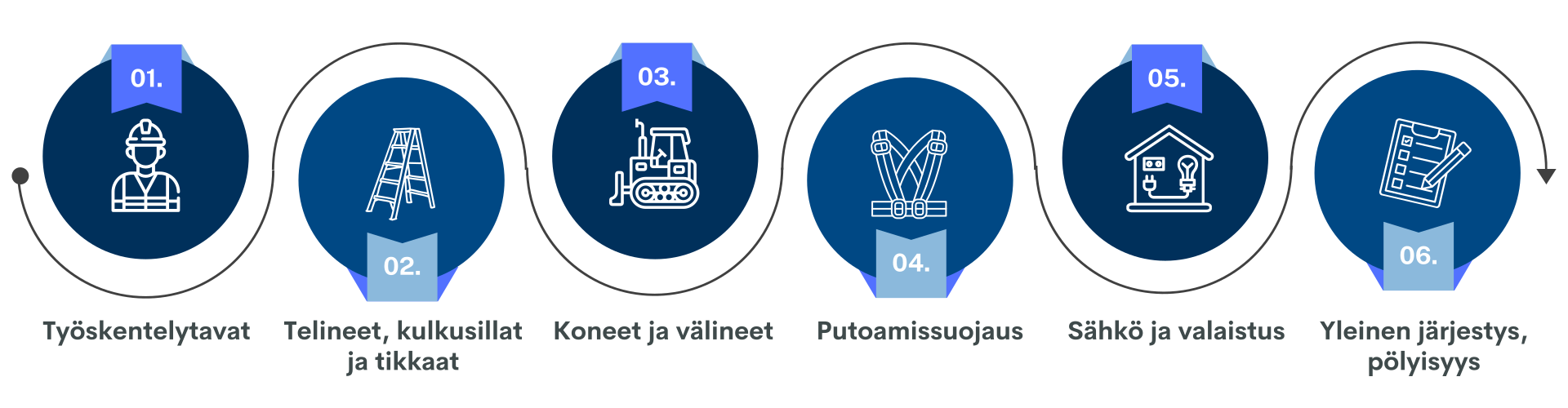 Caption Working methods, Scaffolding, Gangways and ladders, Machinery and equipment, Fall protection, Electricity and lighting, General organisation, Dustiness
Why is the TR meter used?
The TR meter is designed to improve site safety and prevent accidents by detecting deficiencies and risk factors on a construction site before they lead to accidents. TR measurement is not just about identifying problems, but also about monitoring and evaluating the effectiveness of remedial action.By using TR measurement, an organisation can improve its safety culture.
The observations made during the TR measurement are recorded and used to calculate a site safety index, which objectively describes the overall safety level of the site. The index allows comparisons to be made between sites in terms of safety and helps to identify areas for improvement. This comparability encourages companies to continuously improve their safety practices and to commit themselves to improving safety at work.
Is TR measurement mandatory?
The Finnish Occupational Safety and Health Act (738/2002) requires employers to ensure the safety and health of employees at work, and the Government Decree on Construction Site Safety stipulates that weekly maintenance inspections conducted at construction sites are required by law*. The law therefore requires the use of methods capable of identifying and mitigating hazards. Although TR measurement is not mandated by law, TR measurement has established itself in this context, particularly as a tool for ensuring and improving occupational safety in the construction industry. It meets the legal requirements for systematic safety assessment and the improvement of workplace safety at construction sites; furthermore, general guidelines for the construction industry and international standards reinforce the status of TR measurement as a reliable assessment method.
* Weekly maintenance inspections and safety monitoring / Vna 205/2009, 16 §.
Instructions for TR measurement
The TR measurement assesses the safety of a construction site in six key areas using a well-defined methodology. Observations are either correctly or incorrectly marked and the TR level is calculated by dividing the observations marked as correct by all observations.  Working methods – Observations are made of all workers on the site; whether they are following the agreed safety practices. Whether the required protective equipment, such as helmets, goggles or safety shoes, is used correctly and whether fall protection is provided if the person is working in a fall hazard area. One observation is made for each person.
Scaffolding, access bridges and ladders – Check that the scaffolding in use meets safety requirements and is correctly installed. One observation is made for each separate structure or piece of equipment.
Machinery and equipment – Ensuring that tools are in good condition and used correctly. Construction saws, gas welders, grinders, concrete silos, personnel hoists, vehicle cranes, lifting equipment and concrete pump trucks. One observation is made for each. In the case of hand-operated machinery, an observation may be made if deficiencies are found. Gas cylinders should be stored in a supported and upright position. Fire extinguishers used in fire fighting operations are also inspected at this time.
Fall protection – Observe the free edges of levels, stairs and trenches where the fall height is 2m or more. Is fall protection adequate? Edges above 2m should be protected by handrails with three conductors – handrail, intermediate handrail and skirting. The handrail should be at least 1m high. Consideration should also be given to the protection of pedestrian openings and the prevention of guard movement and collapse of trenches. One observation shall be made at each point.
Electricity and lighting – General lighting and lighting for workstations are discussed. Ensure that artificial lighting is adequate for safe movement and quality work. One observation is made of the lighting at each workstation and one box-by-box observation is made of the general lighting. Outside, where daylight is sufficient, no observations are made.
Observations of electrical systems are made one box at a time. Observations are made to ensure that the electrical wires and cables on site are routed in such a way that they do not pose a risk of accident or are not exposed to damage. Electrical switchboards must be suitably located and protected and the wiring must be intact.
Order, waste and dust – This area of observation is divided into a and b, general order on the site and waste management, and dust on the site. The assessment of tidiness is carried out on a grid basis and one observation is made for each grid. The order of the site must allow for good movement and access to goods. Even the smallest piece of debris or waste that poses an accident risk will result in a false observation. Staff rooms, storage containers and waste containers are also observed.
Dustiness is assessed visually and also at the grid scale. Whether there is clearly visible dust at the observation point that is not part of the work process.
Carrying out the TR measurement
The practical implementation of TR measurement involves the following steps:
The worksite is divided into observation areas, i.e. squares
The worksite is divided into smaller sections, such as apartments, column spacing or other logical areas of the worksite. Each box is observed separately.
Observation on a right/wrong basis
In each observation area, specific factors affecting safety are examined. Each observation is systematically recorded: safe practices are marked as “correct” and areas requiring correction are marked as “incorrect.”
Documenting the results
Observations are recorded on a form or in an electronic system. The observations can be used to calculate a site safety index, which allows comparison between sites and gives an overall picture of safety performance.
Reporting and correcting deficiencies
Findings are analysed and reported to site management. Corrective measures are planned and implemented based on the deficiencies found.
Continuous monitoring
Measurements are repeated regularly, at least once a week (Vna 205/2009, § 16), so that the safety level at the construction site remains stable and improves over time.

Benefits of TR measurement
TR measurement acts as a tool for managing immediate risks, but also as a tool for developing a long-term safety culture in the company. It is a simple but comprehensive way of looking at safety on a site and aims to:
Reduce accidents at work – Accurate and regular observation and corrective measures allow early identification of risk factors and prevent accidents.
Establish a uniform safety level – The safety index calculated from TR measurements can be used to assess and compare the safety of different sites.
Improve efficiency and quality of work – Safe working conditions boost work efficiency and reduce the disruption caused by accidents, which can bring work to a standstill.
Promote a culture of safety – Regular measurement makes safety a visible and important part of everyday activities and also engages employees in safe work. As employees’ safety awareness increases, it motivates them to follow good practices as part of their own work.
Analysis of TR measurement results
The observations obtained from the TR measurement are systematically recorded either manually or digitally. The safety index calculated on the basis of the observations provides a numerical value of the safety of the site, making it easier to understand the safety level and to compare it with previous measurements or with other similar construction sites.
The analysis of findings can focus on, for example, the most common or recurring deficiencies. Which aspect of safety has been repeatedly identified as having problems , such as inadequate fall protection or poor site cleanliness.
Whether the prevalence of certain defects increases or decreases with the measurements and what is the relative safety level, i.e. how safe the site is compared to other similar sites.
After analysing the results, the practical measures needed to improve safety areidentified. If, for example, shortcomings in fall protection are identified, measures may include the installation of new guardrails or additional training for workers on fall protection.
The resourcing of the work can be guided by the results obtained. If the maintenance of tools or better cleanliness of the site requires improvement, the management knows how to allocate resources to these areas.
TR measurements should be repeated regularlyto ensure that the improvements made have been effective. The new measurement results will indicate, through the safety index, whether an improvement has been made or whether further action is needed in this area.
By communicating openly about the development of the safety index, the overall safety culture on the site can be improved and at the same time motivate employees to follow safety practices.
Contact us and let’s map out your company’s needs together.